
 Bring Dogheads! into reality, and leave the world to the dogs!
Wednesday, October 28, 2009


Tales: The Real Rapture
"...our greatness lies not so much in being able to remake the world...as in being able to remake ourselves."
Mahatma Gandhi
We're a little like moss on a rock here on earth -a simple colony of life. In the same way that any collective life form experiences stress when the conditions for it's survival begin to change, our world is experiencing some stress. For all of us, as well as each of us, there's a need to adapt.
There's a flaw in our culture's perception of Darwinism. It's not about "Survival of the Fittest." It's about "Survival of What Adapts in the Most Cooperative Way" (see Dr. Bruce Lipton). What carries us through the tough times, with Love. It's an altogether different definition of fitness. It's a spiritual fitness.
The biggest, meanest guy may clobber everyone who disagrees with him, take all the food, and force himself on the prettiest women; but his karma (created by ego and fear) and the failure to evolve spiritually, will cause his destruction (sex specificity intended) – a genetic dead end. The richest guy may have the most secure, most isolated fortress, the largest vault of canned food, and the most guns and ammo; but his isolation and fearfulness will lead to spiritual atrophy, and the inward collapse of his world. Those attributes and characteristics that are associated with Power are dying out, as those associated with Ethics are on the rise. Life on earth is always adapting; the parts that don't, don't last.
Hard times stress the colony, challenging it, forcing it to change; and now we see the shape that change is taking. It's like breaking up bad pottery, and soaking it until it softens and becomes the clay that forms the basis of real life, in order to start over. People are coming together to re-configure their world on that basis – what's actually real and important in life; inspired by a sudden common awareness of what the management of Earth's abundance actually entails, and what the real consequences of continued unconscious exploitation will lead to.
A new cooperation – an evolution – is exploding into reality, based on the spiritual unification of humankind, facilitated by the internet, manifested in an expanding sense of a global community, called to action by the impending catastrophe of climate change. The explosion in clean energy, expanding cooperatives, reuse and recycling, uncontested environmentalism; the elections of Obama, of women, of representatives of diverse religion and ethnic backgrounds; and the impetus for universal health care, local food production, the accelerating growth of animal rights awareness, vegan and vegetarianism, social support systems of all kinds – as well as the public momentum to institute these ethical concepts by means of regulation and legislation (a result of the rise of destructive fascism in the world), is the shape of the change.
Extremists and fundamentalists – religious, financial, racist and militaristic fascists – are dividing themselves off from the majority of peace-loving, compassionate humans, and defining their differences in preparation to be shed from the whole. They actually constitute just a small part of the world's total population. The rise of climate-denying, pro-corporate, racism and fascism actually marks the end of their world. It will be a little messy, but it's happening.
Do everything you can to help it along. If you open your heart, you'll intuitively know what that is. You'll know how to behave, how to shop, how to contribute, how to vote. You already do.
In a manner of speaking, a kind of biblical "Rapture" is actually taking place now amongst those who are awakening to this new consciousness, many of whom are experiencing hard times, and finding themselves and their neighbors falling through the same cracks in the system that allow spiritual evolution to enter. These are fractures in the false world of materialistic consumerism, and a dis-identification with a media that's destructive by corporate design. The Christ Spirit that's returning isn't the bearded redhead in the paintings, it's the spirit of Ethics, Cooperation, Compassion, and Love.
Those who want it all, who think they have it all, who are trying to get as much as they can, and will do anything not to lose it; who want to keep things like they are, who suffer the delusion of their superiority and entitlement, who think they can will the truth to be what they want, are fast being "Left Behind" in their spiritual morass – a private hell of their own making. They won't remain here suffering while the blessed ascend to Heaven, they'll simply become redundant. Their hateful opinions will hold no sway. Their methods of fear-mongering will become ineffective.
Your biggest job may be to help those backsliders you know and care for catch up to the change – by generously applying Love and compassion.
Heaven will return on Earth as we stop poisoning it (because we must), restore natural balance, use free energy, distribute the earth's resources equitably, and evolve into our divine state of spiritual unification. The balance is returning as it must, and if you're part of that change, you needn't worry about the hard times. What truly matters is what each and every one of us keeps in their heart, just be sure it's Love.
"Our present world is conditioned by our present mode of consciousness; only when that consciousness passes from its present dualistic mode...will the new creation appear, which is the external reality of which our world is a mirror."
Bede Griffiths
Read about this and much more in the latest book: How to Get to Heaven (Without Really Dying), Wisdom From a Near-Death Survivor, from Llewellyn Worldwide; and the first book: How to Survive Life (and Death), A Guide To Happiness In This World and Beyond. Both are available everywhere – but ask for them at your local bookstore!
Monday, October 19, 2009

Tales of the Koko Lion, Part 15: A Big Sky Trailer

"A change in the weather is sufficient to recreate the world and ourselves."
Proust
A loud crunch from outside woke me up—an alarm in the silent snow-world outside the trailer door. I opened my eyes, but couldn't quite tell what the heck I was looking at through the breath-cloud above me. It was...a blobby icicle directly overhead—a curious stalactite caused by the frozen condensation of my overnight breath. The little trailer had become a walk-in freezer because apparently, someone had left the door open about a foot wide. The same someone let the propane for the heater run out, and also left the VW stuck up to it's front doors in the snowbank out front. The snow drifting in the door pointed like a white arrow to the perpetrator, who happened to be bundled up in my sleeping bag, and still wearing my clothes.
There I was—there we were—hung-over and snowed-in, in a trailer park just off the road that led from the Gallatin Canyon to Big Sky, Montana. Our answer to the call of the wild. When the older brothers left San Diego and headed to the silver-mine ski town of Park City, Utah, we younger brothers felt we had to push it a little farther.
Park City in the seventies was too safe, too familiar, and we didn't feel like hanging around for the exploitation boom to begin. Already the fur and turquoise crowd from Scottsdale were making their way via Santa Fe, seeping up into the Wasatch, wandering Main Street licking their chops. So Jimmy and I shook our brothers' hands and set sail for Montana, where no kid from San Diego had ever gone before. At least none that we'd ever heard of.
It was a long, eventful trip. That's a hazardous web of highways that crisscrosses the West out there from Wyoming to eastern Oregon, and down to the Arizona border. The cowboy trucker's Bermuda Triangle. Salt flats. Black ice. Nevada. Endless long stretches of road. Trickster spirits dancing past the car in the dark night. You always felt lucky to get where you were going, so when we finally turned up the road to Big Sky, and beheld majestic Lone Peak topping the end of the valley like the Paramount logo, we knew we'd reached at least some lower level of teen-aged legend. No San Diego boys had ever seen this, we thought.
We got jobs at Huntley Lodge, a brand-new resort built by Chet Huntley, half of the long-forgotten iconic NBC News anchor team. We skied all day, and in the evenings waited tables at banquets, playing the image-conscious conferees from Michigan or Minnesota one against the other for ever-bigger tips. I also set-up and bussed at The Yellow Mule—the least appetizing name for a restaurant ever. It was one of my jobs to build a fire in the huge dining room fireplace, and since I was always cold, and always a little angry back then, I built them as big and as hot as I could. Hot enough to render a couple four-tops absolutely un-sit-able. The silver and glassware would start to ping and shimmer—far too hot to touch. The golden light of the fire waved like a mirage around the tables in front of the hearth. Customers would start rubbing their thighs, and the back of their necks, and suddenly leap up clutching their napkins, back-pedaling away from the heat before they spontaneously combusted.
That'd git my boss about as ding-dang teed-off as a cowboy restaurant manager can git. And quite the cowboy he was, pointy-yoked shirts with pearly snap buttons, curly hats, and even scarves tied in such a way as to look a little too decorative for Montana. His name: GREG, was branded in the back of his tooled-leather belt. He walked bow-legged on purpose.
As it turned out, he was from San Diego, about two miles from where we'd grown up.
For some reason, a Montana State Trooper took us under his wing and had set us up in the little trailer park down the road to Bozeman. The crunch that awoke me that morning was that Trooper, delivering the bloody haunch of a road-kill deer by shoving it into the snow bank out front. He left things there for us stuck in the snow, like Boo Radley, with a hole in the snow, instead of the tree. Montana State Troopers can lead lonely lives.
Later in the day after we'd warmed and sobered up, we butchered the venison in the trailer's little bath tub, being careful not to touch the fixtures because of the live electric current that ran through the plumbing. A lot of things out there were not nice, or easy. Like the girls, who were hard to touch too. Like the incessant bitter cold. Like life. This wasn't Park City anymore, Dorothy.
There were rough hill-people from Karst Ranch, who lived almost entirely off the venizon they shot from their cabin windows with their 30-30s. Laconic cowboys and ill-tempered truckers we drank with at a big log roadhouse bar called Buck's T-4, the place where we'd acquired our hangovers and lost our driving skills the night before.
Rosy, the classic veteran waitress I worked with at The Mule, came in late with her husband—the largest man in Montana, who with predictable western irony was nicknamed Tiny. She was always laughing, while Tiny always seemed pissed off. A local asked us where we were from, and when we told him San Diego, he spit old chaw in a cup and said, "Well, I won't hold it aginst ya..." And and a man of his word, he didn't. The cowboy-truckers appreciated that we weren't (quite) hippies, that we worked hard, were good listeners—and that we seemed to hold our liquor well. That was important to them, up in that part of The Rockies, as it was to us too. We'd known when we went there that the legal drinking age in Montana was just nineteen. Jimmy was there already, and I was nearly drinking age upon arrival. So we managed without incident, and realized that in fact, we were real westerners too.
But brother, it was pee-freezin' cold that morning out in front of that trailer, rubbing my hands together hard, looking up at the Spanish Peaks like a row of dog's teeth reflecting the rising sun against that blue, big sky.

Be on the lookout for Tales of the Koko Lion, Memoirs of a Cartoon Mystic, coming your way someday soon(ish).
Read about this and much more in:

Wednesday, October 7, 2009


Tales: On a (Shooting) Star...
"You can't put your foot in the same river twice..." Heraclitus
While I'm here, let me say this about that. Life doesn't seem fair in many respects. Why do some people become movie stars while others are beset by tragedy and struggle? Why are people born with disabilities, or contract terrible illnesses? Why do young children die of incurable diseases?
Because each soul is receiving the precise instruction necessary for their personal evolution. Fundamentally, every life is tragic at the level of mortality. That's one of the reasons why we're here, to break through this form into the Eternal. The tragedies or disabilities are more or less tragic or disabling dependent on the energy they're fed. Some of the most grievous disadvantages are invisible from the outside. Some movie stars are beset by terrible tragedies and struggles. Some laborers are the most serene and contented people on the planet. Some fashion models are suicidal. Some paraplegics shine happiness like the sun.
Have you ever noticed that small children succumbing to terminal illnesses often have the quality of a loving and benevolent teacher, perfect in their wisdom, as serene and knowing in their surrender to The Eternal as the wisest ascended master? They are just what they appear to be. By that point, they can only be exactly what they are. They're only here briefly because they have that one little thing left to do. Maybe just to release fear one last time. It's like they've come back to make sure they turned off the coffee.
Be sad, experience feeling sad, let it's energy move through you until it passes and you come back. Then stop energizing it and energize joy. When the sun sets here, it's always rising somewhere else. It's always there, we are turning to face it.
"If you open yourself to the Tao, you are at one with the Tao and you can embody it completely. If you open yourself to insight, you are at one with insight and you can use it completely. If you open yourself to loss, you are at one with loss and you can accept it completely."
The Tao Te Ching, 23
Thursday, October 1, 2009

Wednesday, September 30, 2009
Tales of the Koko Lion, Part 14: A Date With a Star...

In the years as I was entering High School, my brother dated a beautiful young woman named Jane. She was fresh-faced and true, and very, very intelligent. They went to college together. She supported him – pecadillos and all – bearing witness to the craziness of our home with great grace and compassion. For a while there I had a chance to know a balanced and loving person who lived in their own skin, and while it may not sound like much, at the time it seemed a rare and curious thing to me. Through her I learned a lesson about who we are at our beginnings, and who we can be.
She came from a close-knit family, talented and a bit eccentric perhaps like our own, but right side up. They were supportive of one another's eccentricities with obvious and enviable love (which I now recognize as Source energy), while our own family struggled along living an illusion of wellness.
In the wake of my first teenage break-up, Jane and my brother often encouraged me to date her younger sister, but to me she seemed much too young. At seventeen, drugs and alcohol were all around me, all the time. There'd been trauma at home, and within my peripheral family. Aside from that invisible resumé, I'd been working in the world of adults from an early age and I just felt old already. In my finite teenage wisdom, I didn't see how an innocent 15-year-old girl could possibly have the necessary experience to match my worldly self-centeredness.
I finally succumbed and picked up Jane's little sister for a date to Balboa Park in San Diego (seen as "Xanadu" in the opening of Citizen Kane). Since I've learned that the thing that often offends you most about someone else is caused by the subconscious awareness of that same characteristic in yourself (thank you, Dr. Jung), it follows that I diagnosed Annette as suffering from a case of unconscious vanity. She kept noticing herself in the reflection of store windows, which I couldn't help but notice when I was noticing myself. So she unintentionally made me uncomfortably conscious of me.
After touring the museum, we were sitting on a big park bench making very small talk when Annette suddenly pulled her feet under herself, and stood straight up next to me on the bench. She threw her arms up over her head, rolling her wrists out to push her palms up, and agitating like some fairy princess washing machine she loudly pronounced, "SOMEDAY I'M GOING TO BE A GREAT AND FAMOUS ACTRESS, AND EVERYONE WILL KNOW MY NAME!"
I was casually chagrined. I tapped her on the leg and suggested that she get down as people were looking. And people were looking, and they were smiling. Her future fans were already noticing as Annette was molding the plastic life ahead of her in an altogether good-natured way – and I hadn't a clue what I was witnessing.
She starred in the high school drama club. She went on to the American Conservatory Theater in San Francisco. She broke out in Stephen Frear's popular movie The Grifters, and went on to become a great and famous Academy Award nominated actress. Among other things to her credit in a very accomplished career, she married Warren Beatty and had a family of her own. They're probably a little eccentric, and lovingly supportive of it.
I liked to joke that she settled for second best, but as usual I was painting "funny" over my feelings – flummoxed and intimidated by someone so young who could create their karma with such focused intention, when for so many years I just kept feeling, well clueless. It all makes me smile now – the beautiful accuracy of her park bench prophecy.
Some people are born with symphonies in place, ready to come out by age five. Others enter into young adulthood blossoming into their co-created karma. Annette just knew already. Some people (ahem...) don't know what their purpose is until they've had to survive every other possibility, and like a painful Sherlock Holmes deduction, whatever else remains must be the truth.
Her older sister Jane went on to Johns Hopkins and became a cardiologist, I think...and I think she knew too.
"You have your paintbox and colors.
Paint paradise, and in you go."
Nikos Kazantzakis
Read about this and much more in: How to Get to Heaven (Without Really Dying), Wisdom From a Near-Death Survivor from Llewellyn Worldwide available direct on this page, or online, and How to Survive Life (and Death), A Guide To Happiness In This World and Beyond – available the same ways – but ask for it at your local bookstore!
Thursday, September 24, 2009

Everyone has unseen influences that make up who they are. Influences from inner and outer worlds, from other dimensions of being. In Faith and Mr. Floppy, the kids all have "esoteric energies" that contribute to their personae -in the "real" world, and in magical dimensions. Here's Gideon, Faith's sort-of boyfriend, and Topher, her step-brother, and their respective esoteric selves...
Well Well, Another Metaphor...
"Don't they know who I think I am?"
Koko
A group of people stand looking down into a dry well. They complain about their thirst, about their withering gardens. One man, driven by desperation, at last steps up and climbs down into the well. He begins to dig, at first resenting the work, but then finding an easy rhythm and satisfaction in the effort, until finally he removes that last obstructing bucket of dirt, and breaks through to the great aquafer that flows underneath and through everything. That infuses and enlivens everything. The well begins to fill again with cool water, and bending over, still digging to assure the steady flow of this renewed life, he sees his own reflection in the source. He is this. What he thought he was, who he thought he was is only a reflection of this source.
And when he climbs back out of the well and meets with the various responses of the others-- the heartfelt thanks, the casual acknowledgements, the proud dismissals; he carries with him that source reflection, only vertically now, so that wherever he goes he's looking into that. He sees his own reflection in the the faces of everyone that speaks to him. Their eyes are his eyes. Their fears and foibles and joys and realizations are his own.
"Thou art That"
Chandogya Upanishad, 6.12-14
 So our very own form can provide us with the entry to that new, relaxed, and naturally productive way of seeing the world. Infused and enlivened by that flow. We are all the same thing. We all think the same thoughts and feel the same feelings. And where we used to entertain those cruelties that defined us – the harsh comparisons, snap judgments and righteous justifications, there now lives an easy sense of compassion – the door to source. This sweet and sustaining flow of source that is available to everyone is absolutely free, and totally liberating. It just takes a bit of humility, of "digging" – the honest self-examination that allows us to truly see ourselves. To learn who we really are meant to be, as opposed to who we think we're supposed to be; how did those psychic obstructions to source and purpose get put in place, and how do we remove them?
The most critical facillitating aspect behind discovering this freedom, the metaphor of "going down into the well" (in the prophet Yeshua's story), is finding your inner place of silence where you can gain the calm perspective on who you really are. Your own personal well, where the deepest obstructions between you and your source are hidden.
"In the attitude of silence the soul finds the path in a clearer light, and what is elusive and deceptive resolves itself into crystal clearness."
Mahatma Gandhi
By finding the silence within ourselves, we can individually defuse the demanding inner voice that provides life's running commentary, and then perhaps we can collectively turn off the delusional egoic "reality" that drives our species in ruinous directions. By becoming aware of it, we can strip away the obsessive "story of our life, our country, our people," etc. -the delusional view of life that the Hindu call maya. Christians misinterpret it as sin (in the original greek of the canons: amartia, meaning "to miss the mark"). Buddhists call it selfish craving.
That silence resides in The Tao, The Brahman, The Kingdom of Heaven, in Emptiness, in Source Energy; and in us - within and without us. In that silence, in the absence of anything personal, that power lives. Then we find it's all personal. And we are all that person.
"The Kingdom is inside you, and it is outside you."
Logion 3, The Gospel of Thomas
The book: How to Survive Life (and Death), A Guide To Happiness In This World and Beyond is now available everywhere, but ask for it it at your local bookstore!
Thursday, September 17, 2009
Happiness Redux
When you were a kid, like in Kindergarten, did you have a snack in the afternoon, followed by naptime? You rolled out your mat, the teacher turned out the lights, and you laid there...napping. I used to lay there, wide awake, wondering are all the other kids just laying here wide awake in the middle of the afternoon like me? It wasn't even dark at all. Not even with the lights out. And there were no pillows. I used to lay there and wonder what's the point of this? Why do adults make us do such dumb stuff?
I wish I knew then what I know now. So I wanted to share some of that what by inviting you back to Tips for Happiness, #'s 1, 2, & 3.
I coulda found happiness back then, if I'd known these tips. I'm sure they'll help you find some, and keep some...
Sunday, September 13, 2009

Saturday, September 12, 2009
Tales of the Koko Lion, Part 13: Simon of the Marquesas, conclusion...
"A long time ago, I met a girl while I was fishing in the lagoon on the other side of the island," he said as he waved over the ridge, "...and she had my child. But back then I thought life was only about Simon, so I left the far lagoon and returned to the village." He narrowed his eyes and looked out past the horizon. "There I met another girl, a wild one, and went to live with her. She wanted things, so I went to work on the copra boats – there were many more of them back then. I sailed all over and made money, and spent it all on my life with the wild village woman." He shook his head sadly, looked up into their eyes, and began to turn a little magical.
"One day I was fishing in the lagoon, and a shark swam up to my boat and he began to talk to me. He said: 'This is no way for you to live. You will never be what you are meant to be living your life this way. You must return to the far lagoon, to the girl you left. She is there – I saw her the other day, she is raising your child.You must go back and live there, and take care of your family.' But how can I take care of them, if I do not work the copra boats? I asked him. Il a me dît: 'You will fish in the far lagoon, and you will carve tiki to celebrate the gifts of a true life, and that way you will be able to take care of your family.' Then he swam away." Simon seemed to be telling the God's truth.
"So I left the village woman with all the things I had bought her, and returned to the girl in the far lagoon, and our child, and we had more children. And I took care of my family," he looked around at the kids emerging now from everywhere, smiling, "and I still do...and these are children of those children's children!" He laughed and showed the kids off, and they laughed too.
At that very moment, the Aranui's first horn bellowed out over the bay. Koko asked "How much is the large tiki?" and I think Simon told him two hundred francs, which was only about thirty dollars then, but Koko hadn't brought along any money at all. They said their goodbyes, gave Simon a hug, and hurried back down the hill, but by the time they reached the shore, they knew they had to go back for that tiki. The other tourists were already in the whaling boat. Up to their thighs in the surf, Koko and Grace took up a collection. The woman who'd won a lottery in Ohio lent them the two hundred francs, and they ran back up the valley together in case if they were left, they'd be stuck together for the month until the Aranui's return.
When they got back to Simon's shed, he was waiting for them. The second horn sounded from the ship below. "I knew that you would return." He laughed. " This is your tiki. You had to come back for it." Koko picked up the heavy stone, and felt it's energy charge up his arms and fill his heart. Grace felt it too, standing next to him. They paid Simon, hugged him goodbye again, and Koko folded the tiki into his arms and headed back down the hill, Grace running out in front to hold the boat at the shore, if she could.

By the time they got back to the beach, the crew members were waving them in frantically. The seas had picked up, and it was tough clamoring on board, and even tougher rowing out through the surf. As they pulled up alongside the ship, the waves were pitching the small boat up and down eight or ten feet.
The crew always boarded the paying passengers first, and one of them snatched the tiki as two others hoisted Grace and Koko on board at the top of a wave. They looked back at a worried island woman and her new-born, still being pitched up and down in the boat alongside. One of the rowers took the infant in one hand and raised the little one up overhead with the rising wave. Then, in a magical moment as the wave reached it's peak, a brawny crewman reached down from the Aranui's deck, and as securely and tenderly as you'd pick up a perfect peach, he took the baby with one hand and passed him to safety. On the next violent wave up, he grabbed the mother by her outstretched arm, and as though she were as light as straw, lifted her straight up and on to the deck. They handed her baby back to her as if such things took place every day, because here- of course, they did.
The crew always boarded the paying passengers first, and one of them snatched the tiki as two others hoisted Grace and Koko on board at the top of a wave. They looked back at a worried island woman and her new-born, still being pitched up and down in the boat alongside. One of the rowers took the infant in one hand and raised the little one up overhead with the rising wave. Then, in a magical moment as the wave reached it's peak, a brawny crewman reached down from the Aranui's deck, and as securely and tenderly as you'd pick up a perfect peach, he took the baby with one hand and passed him to safety. On the next violent wave up, he grabbed the mother by her outstretched arm, and as though she were as light as straw, lifted her straight up and on to the deck. They handed her baby back to her as if such things took place every day, because here- of course, they did.
The crew were, to a man, incredible physical specimens. They hoisted and stowed the whaler with easy dexterity. One of them ran like a cat along the railing, despite the wallowing seas. They were some of the most amazing fellows Grace and Koko had ever seen, and every night on the top patio deck, where the free passengers slept under the stars, they brought out their guitars, tiples, and spoons, and sang the most beautiful island melodies.
Koko was thinking of Simon, of his color-of-the-lagoon smiling eyes, as he tried to explain the bomb-shaped volcanic rock past the skeptical Customs officers at L.A. International.
It seemed then that being with Grace would always be, so at the time he failed to pay proper attention to Simon's story of responsibility in love. Likewise, he failed to fully grasp the allegory of the empty materialism of the village woman, and true direction in the words of the shark-spirit, until many years later. He never saw the stone again, Grace kept it when they parted, but he never forgot it's weight, the stone carver's hut, the handing of the baby, or that enchanted night music under a million stars, rolling over the violet South Pacific, the Southern Cross slowly laying over on it's side.
"Life can only be understood backwards,
but it must be lived forwards."
Søren Kierkegaard
The book: How to Survive Life (and Death), A Guide To Happiness In This World and Beyond is now available everywhere, but ask for it it at your local bookstore!
Wednesday, September 9, 2009

Tales of the Koko Lion, Part 13: Simon of the Marquesas.

With the Aranui anchored about a hundred and fifty yards offshore the blue-green Pacific behind them, Grace and Koko trekked up the dry path overlooking the windward side of Nuku Hiva, one of the five Marquesas Islands the little copra freighter stopped at on it's thirty five day trip out of Papeété. They could see the whaling boats carrying materials into shore, and ferrying passengers, local islanders, out to the ship so they could hitch a free ride to one of the other islands, or pay a little for a ride to the Tuamotus, Rangiroa, or back to Tahiti.
The two followed the even incline up out of the creek valley, up the side of the hill where the forest thinned out a bit. The Aranui's "Social Director," a young Frenchman, had told them they might find tiki, his catch-all term for something of interest, up on the hill path, but warned them that with the first sounding of the ship's horn they had to hurry back, because the second horn meant au revoir to all passengers left behind on the island.
It felt like they'd gone a little far, the other dozen or so paying passengers chose to stay below in the village, but something had a hold of them, leading them farther up the path. At first there was just a little girl, about four or five, dirty in a simple cotton dress, pulling on her lower lip. She turned and ran up the path to a small clearing, to a shed coming into view around the bend. As they approached there was another dusty, barefoot boy the same age stepping out of the thatch-roofed shed. He stood behind a crude, homemade table like a counter boy in a shop. On the table was a small selection of stone carvings ranging in size from a few inches long to the largest, an elongated football-shaped stone about thirteen inches long and seven inches across, with a beautiful bas-relief of of a lizard, or a salamander carved out of the top half.
Through the doorway of the shed, they could see a worn wooden mallet and broken screwdrivers on the corner of a little table, and a man's weathered foot in the triangle of sunlight. The man set his foot down on the dirt floor and stood, hitching up his shorts. He stepped out the door of the shed and alongside the little boy.
"Vous ete ici!" he exclaimed in a certain kind of french that Koko could just make out. He said it with that same open- armed lack of surprise that Grace and Koko had been met with so often in their past year of travel around the world. Everywhere they went there were people, usually older local people, who seemed to recognize them- who greeted them like old friends. Like they'd been awaiting their arrival.
"Vous venez pour votre Tiki." the man said, motioning to the table. Koko reached out and shook his rough hand. He was not too tall, a little bent, and very brown, wearing an open short-sleeved shirt. His body was a twilight powerhouse, banded muscles wrapped around his frame, hands and feet splayed and lumpy. His face was deeply creased. His hair was a mass of pushed-back collar-length ringlets, shiny as though with coconut oil, mostly grey with satin black underneath. He was old, but you couldn't tell how old. His eyes shimmered a light blue-green, little versions of the lagoon that rose in him with the tide.
"Je suis Simon. Je fait lés Tikis." His speech was mellifluous and pidgeony as he swung his hand over the table. Koko had a little trouble translating until he watched Simon's eyes, and then his ear began to hear perfectly.
"These are some of my grandchildren and great-grandchildren," he said, rubbing the head of the little boy who hid behind his leg, motioning to the little girl who stood by the shed, pulling on her lower lip. Koko and Grace couldn't seem to take their eyes off the one tiki, the salamander stone. Koko touched it and tilted it up for a look.
"That is the very first creature. It says something to you. Every creature came from that."
" Dessous, tournéz..." Simon says, motioning as though to turn the tiki over. Koko picked it up -it was heavier than he'd expected as he turned it. There on the smooth oval underside, were the cut-in eyes and crescent toothed mouth of a shark. "Aaahhhh..." said the two in unison. Simon's eyes widened as he smiled.
"I'll tell you why the shark," said Simon. "It spoke to me. Il a dit a moi..." Then he began to tell his story...
Wednesday, September 2, 2009
Czech it Out!
With a nod and a wink to my Bohemian heritage, a small tribute to a couple great Czech illustrators. First up, Miroslav Sasek, whose wonderful This Is line of kids' books is being reissued..


...his work reminds one of his Romanian contemporary, Saul Steinberg... Next, the great Josef Lada. His seminal illustrations for the Czech classic, The Good Soldier Svejk, written by Jaroslav Hasek, have been a huge inspiration to lots of graphic and ligne claire illustrators like one of my heros, Ever Meulen. Here is the classic Svejk!
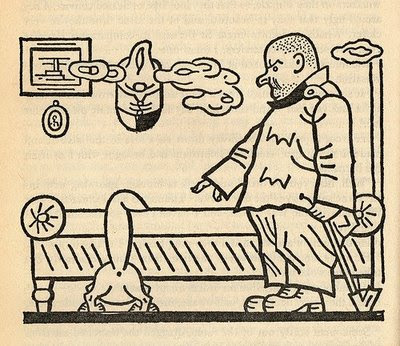
 Next, the great Josef Lada. His seminal illustrations for the Czech classic, The Good Soldier Svejk, written by Jaroslav Hasek, have been a huge inspiration to lots of graphic and ligne claire illustrators like one of my heros, Ever Meulen. Here is the classic Svejk!


Subscribe to:
Posts (Atom)


