
Thank goodness this Valentine's Day device didn't have to spell itself!

Happy Valentine's Day!


Just for fun – a continuation of the "architecture" necessary to design for 3-D animation; in this case for PBS Kids "Word World," where not only do you have to use an architect's sensibilities to design buildings and locations, but also to design things...some that need to be built out of their own words (Word World is "Where Words Come Alive"), some that gratefully don't. Here the design takes on the quality of product design, or toy design (which it occasionally ends up being...)
Like these first two– it wouldn't really make sense to build something that read: "Automatic Cake Frosting Gun on Wheels," or "Valentine Making Machine;" nor would it ever be possible in the space allowed. Still, you have to start with an idea of the thing in all it's 3 dimensions:
 This rough idea might demonstrate just what the thing can do...
 Then from b/w plan, to color...
 Things that need to be constructed out of the letters of their own word can be a little trickier. 'The Educators' have to make certain that legibility isn't going to be an issue (especially for the littlest viewers)...
  Here's the gray model, for revisions, before painting...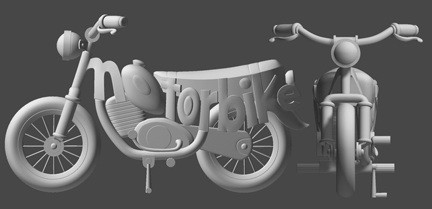
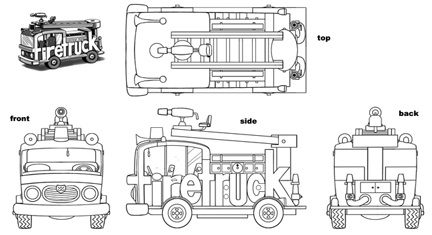


 ....................................and don't forget space for the action figures!
 In Word World, every 3-D location had to be built, much like it would be in the real world. Following the visualizing sketch, there'd have to be an architectural plan, showing all the angles that the model builders need to make the new locale into a space where our 3-D actors can work...


 This is to announce that I've just completed an update of my website, with the help of Mike Perkins at Setstatic. Aside from a new palette, there's lots of new material to see in Animation Design & Art Direction - with a whole new Development Art & Design page (featuring three new projects); a bunch of new Word World, Season Three; and an all-new Online Design page. I hope you enjoy it! Thanks, Mike.
 Start with a drawing, a lot like an architectural plan...
 Get it built in a 3-D grayscale version...
 Designing for 3D requires a lot of architecture. As you see here, not only for architectural locations, but also for the creation of characters. It's necessary to be technically specific even when it comes to aspects of the character's "charm." Notice how the "a" changed from the plan drawing to the color model, to enhance legibility.
 ...this 3/4 rear drawing is by the very talented Kevin Kobasic, who did the original turn-arounds of the cat character, as well as a lot of other characters on the show.


